Home Aesthetics
The $50 Glow-Up: Refining Your WFH Video Presence
Transform your video call aesthetic and eliminate shadows with a precise, budget-friendly lighting setup that integrates seamlessly into your home decor.
6 min read
 Practical guides to Lifestyle and inspiration
Discover why your brain prefers either visual silence or curated chaos to produce its best work based on cognitive science and design principles.
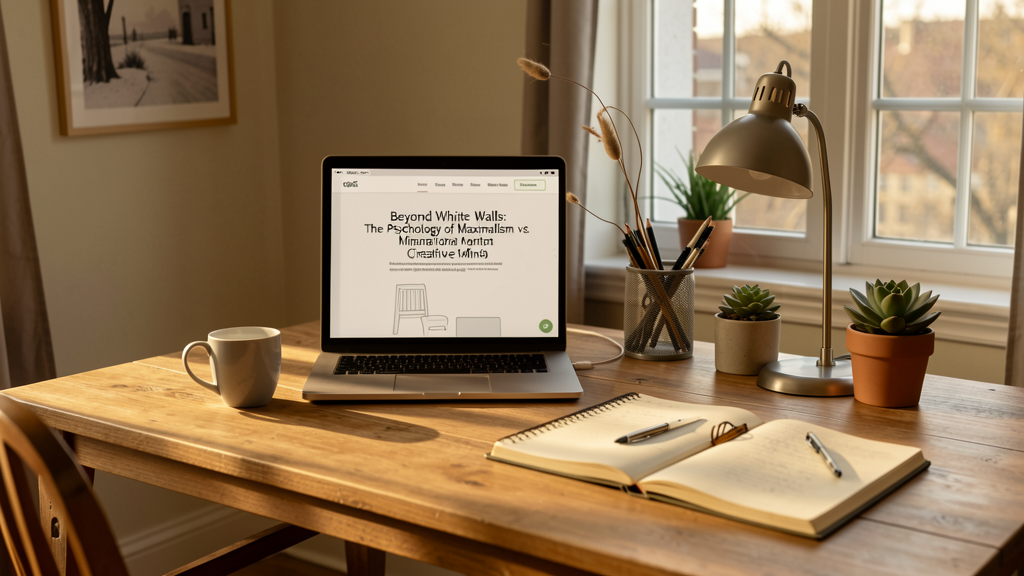
Editorial image illustrating Beyond White Walls: The Psychology of Maximalism vs. Minimalism for Creative Minds
The debate over interior design aesthetics has long been dominated by visual preferences, yet for those of us who work, create, and think within these spaces, the stakes are much higher. In 2026, as our homes continue to function as hybrid sanctuaries for rest and relentless production, the arrangement of our immediate environment directly dictates the quality of our mental output. I have spent years observing how design trends cycle, but the tension between the "less is more" doctrine and the "more is more" rebellion remains the most critical decision for a creative professional.
The choice between maximalism and minimalism is not merely a matter of taste; it is a strategic decision about cognitive resource management. When we choose a style, we are choosing how our brains process information, handle distraction, and trigger inspiration. To understand which approach truly boosts creativity, we must look past the color palettes and furniture arrangements and examine the psychological machinery at play.
Minimalism is often marketed as the ultimate cure for a distracted mind, and there is substantial neurological evidence to support this. The aesthetic relies on the principle of "negative space"—the breathing room around objects—which allows the eye to rest and the prefrontal cortex to reset. When you enter a minimalist environment, the brain does not have to expend energy filtering out visual noise. This reduction in cognitive load is theoretically perfect for "deep work," the state of concentrated focus required for coding, writing, or complex analysis.
However, there is a tipping point where clarity becomes sterility. I have visited minimalist homes in 2026 that feel less like sanctuaries and more like sanitized laboratories. When an environment lacks visual anchors, the brain can sometimes become hyper-aware of its own internal chatter. For creatives who rely on external stimulation to spark associative thinking—connecting two seemingly unrelated ideas to form a new one—a stark, monochromatic room can feel like a sensory deprivation tank. The "Zen" ideal can backfire, leading to a creative block born not from distraction, but from a lack of fuel.
Furthermore, the pressure to maintain a minimalist space can induce anxiety. The aesthetic demands a constant curation process, a rigorous discipline to keep surfaces clear. For a writer or designer, this subconscious pressure to "tidy up" can hijack the mental bandwidth needed for creative problem-solving. If your WFH desk setup is pristine but you are paralyzed by the fear of messing it up, the design has failed its primary function.
Conversely, maximalism embraces the chaos of the human experience. It is an aesthetic of abundance, characterized by saturated colors, layered patterns, and a "more is more" philosophy regarding decor. Psychologically, maximalism operates on the concept of "stimulus diversity." By filling a room with art objects, textures, and books, you create a dense environment rich with associative triggers. A vintage rug might trigger a memory; a clash of bold colors might provoke a visceral emotional response; a collection of oddities might inspire a narrative arc.
For artists, marketers, and brainstormers, this environment can be a goldmine. The theory of "incubation" suggests that creative ideas often germinate when the mind is occupied with a secondary task. In a maximalist room, the visual stimuli serve as that secondary task, keeping the brain active and making connections in the background. It is the difference between staring at a blank page and staring at a mood board.
Yet, the danger here is obvious: sensory overload. A room that is too busy can fragment attention, making it impossible to sustain a single train of thought for longer than a few minutes. The maximalist approach risks inducing decision fatigue before the work day has even begun. If you have to process visual data from twenty different art pieces just to sit down with your morning coffee, you are starting the day with a depleted cognitive budget.
There is also the logistical reality of living with so much stuff. I often see clients who love the idea of maximalism but struggle with the reality of it. It requires an immense amount of curatorial skill to ensure that a room feels "collected" rather than "cluttered." Without a rigorous underlying structure, maximalism can quickly devolve into hoarding, which creates a stress response that is anathema to creativity.
The decision between these two extremes should not be arbitrary. It must be based on how your specific brain processes information and the type of creative work you do. This is where we move from design appreciation to environmental psychology.
If your work requires high-stakes analytical focus—like a financial architect or a software engineer—minimalism is likely the superior framework. You need to protect your working memory. However, you must avoid the trap of "clinical minimalism." The solution lies in "warm minimalism." Introduce texture through natural fibers like wool or jute, and incorporate organic shapes that soften the hard lines of modern furniture. You can also manipulate the atmosphere to support focus without adding visual clutter. Scent layering, for instance, can define a workspace using olfactory cues (like rosemary or peppermint for alertness) without adding a single visual object to the room.
If your work is generative—requiring you to invent new concepts, write fiction, or design brands—you likely lean toward maximalism. But to make it functional, you must practice "zoned maximalism." You cannot have high-intensity visual stimulation everywhere. The trick is to create pockets of intensity surrounded by neutral buffers. Perhaps your living room is a riot of color and pattern, serving as your ideation zone, while your actual workspace is dialed back to a moderate level of stimulation. This allows you to retreat to the "mess" for inspiration and return to the "clean" for execution.
A common error I encounter in 2026 is the misunderstanding of spatial proportions. A maximalist approach in a small studio apartment often results in a claustrophobic environment that stifles thought rather than stimulating it. Before committing to this style, you must be ruthless about decor mistakes that make your living room look smaller. If the physical space restricts movement, the mind follows suit; physical constriction leads to conceptual constriction.
After two decades of critiquing interiors, I have found that the binary choice is a false dilemma. The style that actually boosts creativity in 2026 is not one or the other, but a sophisticated hybrid I call "Structured Abundance."
This approach acknowledges that humans are complex; we crave safety and adventure, silence and song. Structured Abundance takes the architectural discipline of minimalism—the clean lines, the organized storage, the high-quality base furniture—and applies it as a canvas. It then allows for maximalist expression in the mutable layers: the art on the walls, the books on the shelves, the objects on the tables.
My strong recommendation is to build a minimalist "hardware" for your home. Invest in excellent, simple cabinetry and neutral wall colors that provide the mental reset your brain needs during high-stress periods. This infrastructure supports mental clarity by keeping daily life detritus out of sight. Once that foundation is laid, you can apply maximalist "software" with zero guilt. Curate your chaotic elements freely, knowing you have the structural support to hide them away when the work requires total isolation.
This philosophy solves the reader's dilemma of supporting both mental clarity and creative thinking. You get the clarity from the underlying order and the inspiration from the layered complexity. You are not forced to choose between a monk's cell and a bazaar. You get to inhabit a space that understands the need for both a blank slate and a rich tapestry.
The ultimate goal of home aesthetics is not to adhere to a magazine trend, but to build a prosthetic device for your mind. If you find yourself staring at a white wall and feeling numb, you have gone too far. If you find yourself frantically cleaning piles of magazines to find your laptop, you have swung too hard the other way. The sweet spot lies in the tension between the two, a space that holds your silence and your noise with equal grace.

Transform your video call aesthetic and eliminate shadows with a precise, budget-friendly lighting setup that integrates seamlessly into your home decor.
Move beyond the limitations of single-note candles by mastering scent layering to build a complex, lingering atmosphere that feels uniquely yours.