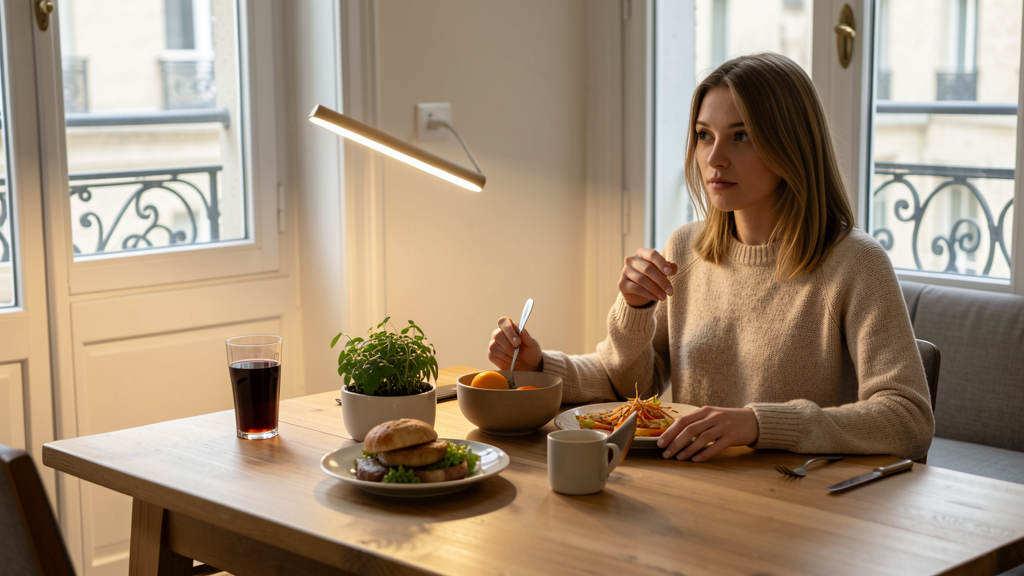
Editorial image illustrating Eating Alone in Paris: How I Traded Anxiety for a Three-Course Experience
The rain was coming down in that persistent, grey drizzle Paris does so well in early May. I was standing under the awning of a pharmacy near the Odéon, staring at the window of a bustling bistro. Inside, warm amber light spilled onto zinc countertops, and the smell of brown butter and shallots wafted out every time the door swung open. I was starving, having subsisted on a single espresso and a hurried croissant since dawn.
Yet, I did not go in. I couldn’t.
Instead, I turned left, walked three blocks in the rain, and bought a sad, pre-packaged sandwich from a Monoprix convenience store. I ate it on a wet bench in the Jardin du Luxembourg, hunched over like I was protecting state secrets, trying to finish it before anyone noticed I was there. This was the third time this week I had done this. I was in Paris—the culinary capital of the world—and I was treating mealtime like a covert operation to be executed quickly and privately.
The problem wasn't the food. The problem was the table for one.
For years, my travel strategy was designed around a specific avoidance: avoiding the moment where a host asks, "Table for one?" avoiding the walk of shame to a small two-top where the empty chair stares at you like a judgmental ghost. I would skip lunch to avoid the awkwardness or grab fast food to eat while walking. But standing in the rain that evening, cold and clutching a plastic wrapper, I realized I was letting a phantom anxiety dictate the terms of my life. I decided then that tomorrow, I would not eat on a bench. I would make a reservation.
The Les Antiquaires Experiment
The next morning, I formulated a plan. I knew I couldn't just walk into a place; I needed a structure to hold me accountable. I chose Les Antiquaires, a small, lively spot in the 7th Arrondissement known for its excellent duck confit and, crucially, its tight seating arrangement. My reasoning was that if the tables were packed, I wouldn't feel like an island; I would be part of the density.
I arrived at 7:45 PM. The door was propped open. I stood on the threshold for a full ten seconds, my heart hammering against my ribs. The maître d', a man with a perfectly pressed white shirt and a mustache that defied gravity, looked up. He didn't look pitying. He looked busy.
"Monsieur? Bonsoir."
"Bonsoir," I said, my voice tighter than usual. "Une table. Une personne."
He didn't blink. He grabbed a heavy leather-bound book, scanned it, and nodded. "Oui, intérieur or terrace?"
"Intérieur," I blurted out, fearing the terrace would expose me to the street.
He led me to a small table against the wall, right in the thick of the room. To my left was a couple arguing intensely about art; to my right, a woman dining alone who was reading a paperback and sipping wine. She looked completely at ease.
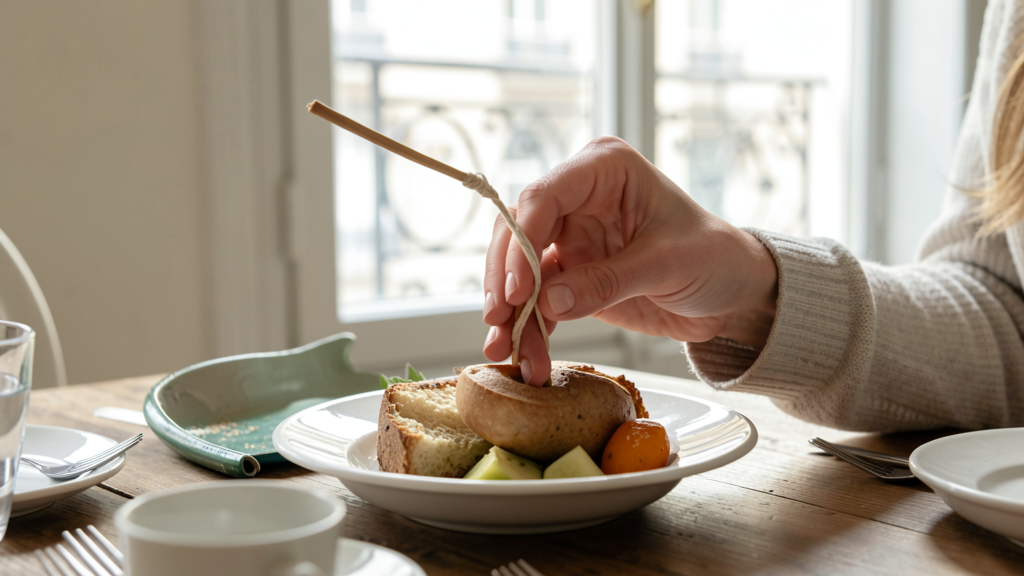
The waiter arrived. I ordered a glass of Saint-Émilion and the escargots to start. The waiting game began. This is usually the panic point—the moment where you fumble for your phone and scroll through emails you've already read ten times just to look busy. I caught myself reaching for my pocket. I stopped.
I looked at the room instead. I watched the waiter balance three plates on one arm. I noticed the molding on the ceiling—a intricate Art Deco pattern I would have missed if I were staring at a screen. I took a sip of wine. It was good. Really good. Suddenly, I wasn't "the guy eating alone"; I was a guy drinking wine in Paris. The shift was subtle but seismic. The anxiety wasn't gone, but it was replaced by a fierce sense of presence.
Designing the Solo Experience
As a Home & Decor editor, I spend my life analyzing how spaces function and how they make us feel. I realized my dining anxiety was largely a spatial problem. When we sit at a table, we are conditioned to expect an interaction across the table. When that space is empty, the composition feels wrong to our brains, like a painting with a gaping hole in the center.
The solution wasn't to brave the awkwardness; it was to redesign the furniture arrangement of my social life. I needed to create a scenario where the empty chair didn't matter. Over the next few days, I developed a method based on functional design principles that turned solo dining from a liability into a luxury.
The Anchor Object Protocol
I stopped relying on my phone as a shield. It's a defensive object that signals "I am not present, do not perceive me." Instead, I started carrying a physical notebook and a nice pen. This changed the dynamic entirely. Writing in a notebook is an active, aesthetic activity. It frames you as an observer, a thinker, or a creative.
At Les Antiquaires, I sketched the layout of the salt shaker. It gave my hands something to do that wasn't tapping glass. I was no longer hiding; I was working. The notebook acted as a physical anchor, giving the table a purpose beyond just "holding the food." This small shift in props completely altered how I carried myself.
Strategic Seating Geometry
Where you sit dictates your experience. I learned to request specific spots that offered visual engagement rather than isolation. A table in the center of the room can feel like a stage, but a table facing the room—perhaps at the bar or a banquette along the wall—turns the restaurant into your entertainment.
On my third night, I sat at the bar of a wine bar near Canal Saint-Martin. I had a direct view of the sommelier organizing the bottles and the chef plating charcuterie. I was facing the action. I had a brief conversation with the bartender about the natural wine list, something that never would have happened if I was tucked away in a corner booth facing a wall. Designing your "view" solves the boredom that often fuels social anxiety.
The Course Pacing Strategy
When we eat with others, the pace is set by conversation. When alone, there is a risk of rushing—eating, paying, leaving—to minimize the "exposure time." I inverted this. I treated the meal as a sequence of distinct events. I ordered three courses. I forced myself to wait between the main course and the cheese plate. I watched the room change as the evening progressed.
This pacing serves a functional purpose: it normalizes your presence. If you stay for two hours, you become part of the furniture. You are no longer the "solo diner" who came and went; you are a fixture of the restaurant's nightly narrative. By extending the duration, I gave myself permission to inhabit the space fully.
Why Aesthetic Beauty Matters When You Are Alone
There is a practical reason to choose beautiful restaurants when you are on your own. In a group, the conversation is the decoration. You could be eating in a concrete bunker and still have a good time if the company is right. When you are alone, the environment is the company.
I found that my anxiety plummeted in spaces with strong design identities. Places with tactile tablecloths, fresh flowers, and thoughtful lighting provided a level of sensory stimulation that filled the void. At a bistro with paper tablecloths and fluorescent lighting, I felt exposed. At a brasserie with velvet banquettes and dim sconces, I felt held.
This relates to my philosophy on the concept of 'slow travel' and why it saves you money. When you slow down and invest in a high-quality meal, you aren't just paying for calories; you are paying for the environment that sustains your emotional well-being. A long, beautiful lunch costs less than a frantic day of shopping for distraction items you don't need. It is a form of self-care that doubles as cultural immersion.
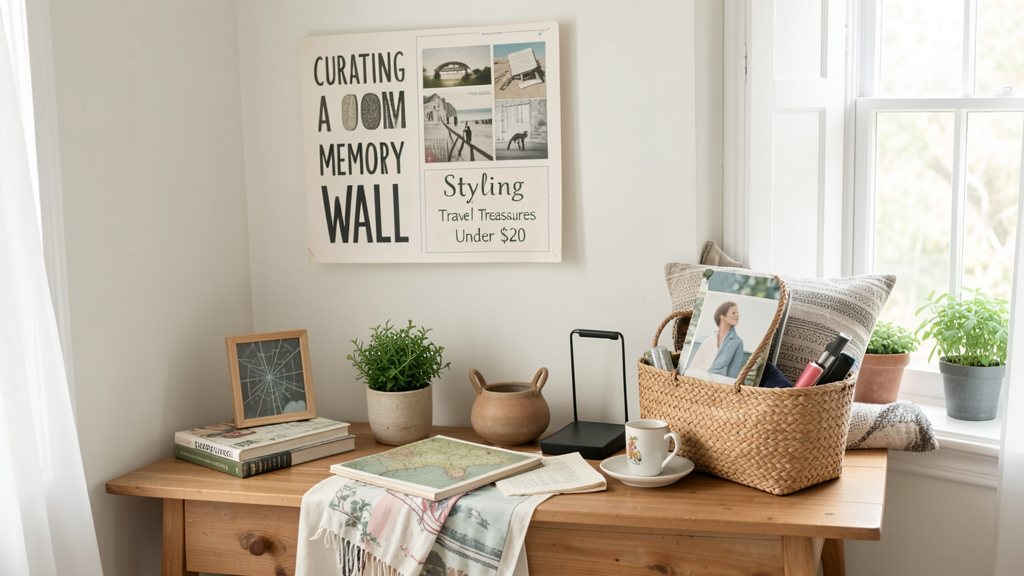
I started collecting restaurant matchboxes and taking photos of the specific floral arrangements on the tables. This wasn't just hoarding; it was the beginning of building a memory wall with travel souvenirs under $20. These physical tokens grounded the experience, making the fear feel small and conquerable in comparison to the beauty I was collecting.
The Liberation of the Solo Table
The fear of solo dining is really a fear of judgment. We worry that everyone is looking at us, pitying us, or wondering why we have no friends. The reality, I discovered over a week of forcing myself into restaurants, is that no one cares. People are too worried about their own dates, their own arguments, or their own steak frites to notice the man at table four writing in a notebook.
By the end of my trip, I had eaten at five different restaurants alone. I had consumed snails, steak tartare, and more crème brûlée than is medically advisable. I had spent hours watching Paris flow past windows.
The liberation wasn't just about the food. It was about reclaiming my time. I didn't have to wait for anyone else to be hungry to eat. I didn't have to make small talk when I wanted to be silent. I could be exactly where I was, doing exactly what I was doing, without apology.
I returned from Paris with lighter luggage, largely because I realized I didn't need to pack half the "entertainment" items I usually bring to distract myself on trips. If you are looking for items you should never pack for a one-week European trip, add the "security tablet" to the list. You don't need to hide behind a screen. You just need to pull out the chair, sit down, and ask for the menu.
Mastering the solo meal does more than improve your travel photos; it proves to you that you are enough company for yourself. And in a world that is increasingly loud and connected, that might be the most luxurious feeling of all.