Mindful Growth
Digital Minimalism vs. Productivity Apps: Which Truly Saves Time?
Analyze the trade-off between decluttering your digital life and stacking productivity tools to discover which approach actually lowers your cognitive load.
6 min read
 Practical guides to Lifestyle and inspiration
A micro-journaling framework designed to bypass morning paralysis by connecting your present anxiety with your future, grounded self.

Editorial image illustrating The Two-Minute Future Self Journaling Method for Instant Clarity
The alarm sounds at 6:30 AM on a Tuesday in March, and before your eyes even open, the static begins. It is not a loud noise, but a low-frequency hum of dread—a cognitive load composed of three unanswered emails, a looming deadline for the Silva project, and the vague guilt about skipping yoga yesterday. By the time your feet touch the floor, you are not just waking up; you are already catching up. This state, which I call "anticipatory exhaustion," is the default operating mode for many of us in 2026. We wake up depleted, bracing for a day that hasn't happened yet.
I have spent the last decade studying the intersection of lifestyle design and mental clarity, and if there is one truth I have encountered repeatedly, it is this: anxiety loves a vacuum. When you wake up without a concrete direction, your brain will instinctively fill the gap with worst-case scenarios. We often look for complex solutions—overhauling our entire schedule or adopting a new productivity stack—but the remedy is often much smaller and more surgical.
The "Two-Minute Future Self" method is not about vision boards or manifesting a dream life. It is a tactical micro-journaling habit designed to bridge the neurological gap between your panicked morning self and the grounded version of you that exists six hours from now. It creates a line of sight.
The physiological reality of the cortisol awakening response (CAR) means that your stress hormones naturally spike within the first hour of waking. In a perfect environment, this spike provides energy. In our current environment, saturated by notifications and the ambient pressure of hyper-connectivity, this spike manifests as mental fog.
We often mistake this fog for a lack of discipline. We think, "I can't focus," so we reach for external tools to force focus. However, I have found that constantly switching between different productivity apps often exacerbates the scatter rather than fixing it. As we explored in the comparison between Digital Minimalism vs. Productivity Apps: Which Truly Saves Time?, the tool is rarely the bottleneck; the bottleneck is the lack of an internal anchor.
When you wake up with a cloud of anxiety, your brain is scanning for threats. It perceives the unfinished tasks as predators. The goal of this method is to signal to your amygdala that you are safe and that you have a plan, thereby shifting control back to the prefrontal cortex.
This process requires a physical notebook and a pen—not a phone. The tactile act of writing slows down your racing thoughts, forcing a single-pointed focus that typing on a glass screen cannot replicate. You are not writing a diary entry; you are executing a protocol.
The entire sequence takes exactly two minutes. Set a timer if you must, but eventually, the rhythm will become intuitive.
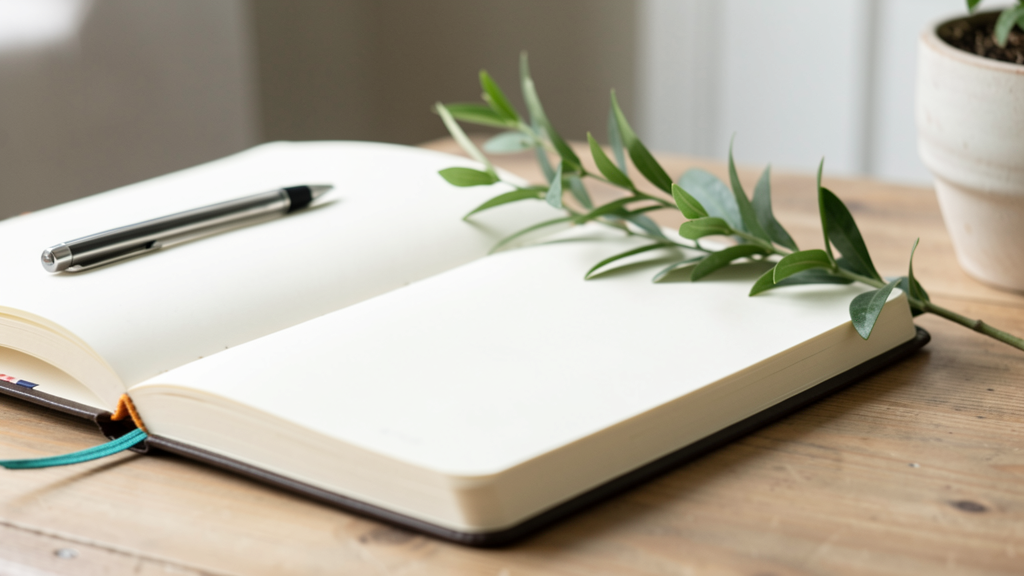
Open your notebook to a fresh page. Do not write the date. Do not write a header. Instead, write down exactly what is bothering you right now, but restrict it to three bullet points. No sentences. No explanations. Just raw data.
Example:
By externalizing these vague monsters onto paper, you turn a feeling of "overwhelm" into a defined list of items. This practice relies on a concept known as emotional granularity. When you can label the specific components of your anxiety, the emotion becomes less overwhelming and more manageable.
Skip two lines. Write the time exactly six hours from now. If it is 6:30 AM, write "12:30 PM."
Now, answer this single question in one sentence: "What does the 12:30 PM version of me need to have handled to feel relieved?"
You are not asking what you want to do. You are asking what your future self needs you to have handled. This shifts your perspective from immediate panic to strategic care.
Example: "By 12:30 PM, I need the outline for the Silva deck complete so I can enjoy lunch without a knot in my stomach."
Under that sentence, write the first physical action required to make that outcome true. Be painfully specific. "Work on presentation" is too vague. "Open the Keynote file and type the title slide" is an action.
Example: "Open laptop, launch Keynote, type 'Project Silva: Q2 Review' on the title slide."
Write a brief statement of acceptance to your future self.
Example: "I am handling this now so 12:30 PM me can breathe."
Close the notebook. Stand up. You are done.
Skeptics often argue that two minutes is too short to make a dent in deep-seated anxiety. There is validity to this skepticism. If you are dealing with clinical anxiety or trauma, a journaling prompt is not a substitute for professional care. However, for the day-to-day friction of modern life, the power lies in the interruption.
Anxiety is a loop. It feeds on itself by spiraling from "I am worried about X" to "I am worried that I am worried." This method breaks the loop by introducing a foreign element: the future.
When you write to your future self, you are engaging in "prospective psychology." You are forcing your brain to simulate a successful outcome rather than a catastrophic one. The trade-off here is that you must surrender the illusion of multitasking. You cannot clear your mind while checking your email. You have to commit to being entirely present with the pen for those 120 seconds.
I have seen clients struggle with this because it feels too simple. We are culturally conditioned to believe that solutions must be arduous to be effective. But efficiency is often quiet. If you spend two minutes gaining clarity, you save the two hours you would have otherwise spent doom-scrolling to avoid the work.
There is a specific caveat to this method that I must address. Visualizing the future can sometimes trigger panic if the gap between "here" and "there" feels too wide. If writing about your 12:30 PM self makes you feel like a failure because you don't believe you can get there, adjust the timeframe.
Instead of looking six hours ahead, look one hour ahead. Or thirty minutes.
"By 7:30 AM, I need to have finished my coffee and be dressed."
Shrinking the gap reduces the threat level. The goal is not to transform your life in two minutes; it is to lower the volume of the noise so you can hear your own thoughts. If you find yourself using this exercise to berate yourself for not being further ahead, stop. You are likely dipping into learning for ego rather than growth—using the journal as a weapon rather than a tool.
In those moments, I recommend switching from a "doing" focus to a "being" focus. Write down how you want to feel at 12:30 PM, rather than what you want to have done. "I want to feel patient." Sometimes, the clarity we need is not about our task list, but about our emotional state.
The most profound effect of the "Two-Minute Future Self" method is not what happens during the two minutes, but what happens in the silence that follows.
When I first started experimenting with this in late 2025, I expected it to improve my productivity. It did. But the surprising side effect was a decrease in my resentment toward my obligations. By explicitly negotiating with my future self—promising to handle a task so she could rest—I began to view my work as an act of service to my own well-being, rather than a demand from an external boss.
This method changes the narrative. You are no longer a victim of a busy schedule; you are the architect of a calm afternoon. You wake up, you see the fog, and you deliberately build a bridge through it.
As you move through your day today, try not to view the practice as another item on your to-do list. It is the opposite. It is the moment you step off the treadmill. You write the anchor action, you close the book, and you realize that the anxiety was just a lack of direction, not a lack of capacity. You have the direction now. The rest is just mechanics.
Analyze the trade-off between decluttering your digital life and stacking productivity tools to discover which approach actually lowers your cognitive load.
Learn to distinguish between vague distress and specific feelings to instantly lower emotional reactivity and gain control over your mood.