Editorial image illustrating The 3-Minute Gua Sha Routine for a Natural Morning Lift
The alarm goes off at 6:30 AM. You drag yourself to the bathroom, flip the switch, and stare back at a reflection that feels vaguely like a stranger. The eyelids are heavy, the jawline undefined, and the cheekbones seem to have gone into hiding overnight. We have all been there. This phenomenon, known as morning edema, is simply fluid retention that accumulates while we sleep horizontally. While cold water splashes and caffeine offer temporary relief, they often fail to address the mechanical cause of the puffiness.
In my work as a Mindfulness Director, I advocate for practices that ground the body while solving aesthetic problems. Gua Sha, an ancient East Asian therapy, fits this mandate perfectly. It is not just about "scraping" the skin; it is a deliberate manipulation of the fascia and lymphatic system. When done correctly, this routine acts as a manual pump, moving stagnant fluid away from the face and toward the lymph nodes for drainage.
The beauty of this practice lies in its brevity. You do not need a twenty-minute facial to see results. You need three minutes, the right tool, and a specific map of movements. If you are looking to replace the "morning mask" look with a sculpted, awake complexion before you even think about applying concealer, this guide is your actionable toolkit.
Why Morning Lymphatic Stagnation Happens
Before touching the tool, we must understand the physiology. The lymphatic system is a network of vessels that carries waste and toxins away from tissues. Unlike the circulatory system, it does not have a pump (the heart) to keep things moving. It relies on muscle movement and gravity. During the night, you lie still for hours. Gravity pulls fluid downward, and the lack of muscle movement allows it to pool in the face, particularly around the eyes and cheeks.
This stagnation results in that "tired" look. Foundation settles into creases you didn't know you had, and under-eye circles appear darker. By manually stimulating the lymphatic pathways, you are essentially turning the pump back on. You are signaling the body to flush the excess fluid.
However, there is a caveat. Gua Sha requires medium. You cannot drag a stone across dry skin. This causes friction, which can lead to micro-tears and inflammation—exactly what we are trying to reduce. For this routine, use three to four drops of a facial oil that suits your skin type. I recommend jojoba or rosehip oil for 2026 mornings, as they penetrate quickly without leaving a greasy residue that interferes with makeup application.
Preparation: The Temperature Trade-off
A common question I receive in my workshops concerns the temperature of the stone. Should it be frozen? Room temperature? Heated? For morning puffiness, the answer is cool, not frozen. Placing a stone directly from the freezer onto the delicate skin of the face can shock the system, causing capillaries to constrict too aggressively. A stone that is cool to the touch—kept in a glass of water on your nightstand or simply at room temperature in a cool room—is ideal. The slight coolness acts as a vasoconstrictor, tightening blood vessels, while the massage movement mechanically drains the fluid.
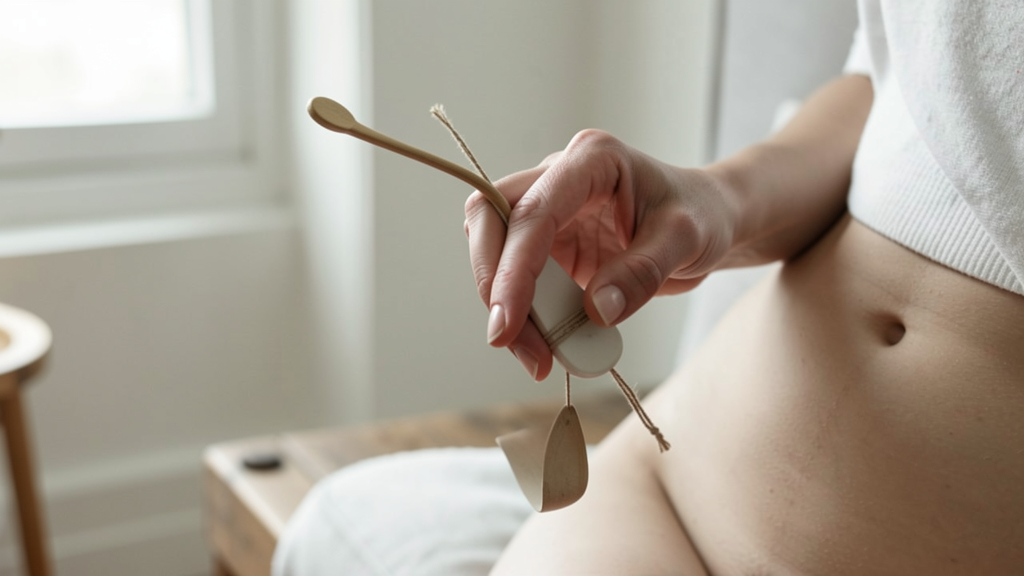
Posture also plays a role here. Do not hunch over the sink. Stand tall, roll your shoulders back, and breathe deeply. This opens up the neck and clavicle area, which are the final destinations for the fluid we are about to move. If your neck is compressed, the drainage cannot exit the face effectively.
Does the Stone Material Really Matter?
Walk into any beauty store, and you will see Gua Sha tools made of jade, rose quartz, bian stone, and even stainless steel. Does it matter? Functionally, yes, but perhaps not for the reasons marketing departments suggest. The "energy" of the stone is subjective, but the friction coefficient is not.
Rose quartz, which I keep in my own kit, tends to have a slightly denser, cooler composition than jade. Bian stone is known for its high thermal conductivity. For the purpose of depuffing, density is key. A heavier stone requires less pressure from your hands to do the work. You want the weight of the tool to provide the downward pressure, not your own muscle force. If you find yourself pressing hard to feel an effect, your tool might be too light or too smooth.
7 Essential Movements to Sculpt and Drain
This sequence is designed to take exactly three minutes. Perform each movement three to five times on each side of the face. The pressure should be firm but comfortable—think about 60% of your maximum pressure. We are aiming for a "feel-good" ache, not pain.
1. The Decolletage Flush
Start here. Never begin on the face. You must clear the "highway" before you can drive the cars. Place the flat side of the Gua Sha tool at the center of your chest, just below the collarbone. Glide the tool outward, following the curve of the collarbone toward the shoulder. Then, sweep down the neck toward the armpit. This opens the main drainage pathways near the supraclavicular lymph nodes. If you skip this, the fluid has nowhere to go.
2. The Neck Sweep
Move to the neck. Tilt your chin slightly up. Hook the tool (using the curved inner edge) at the base of the neck, right in the center. With the tool angled at roughly 45 degrees, sweep upwards and outwards along the jawline, ending just below the earlobe. You might feel a slight tingling or release of tension here. We carry immense stress in the sternocleidomastoid muscle, and this movement helps unlock it, instantly elongating the neck visually.
3. The Jawline Definition
This is where the transformation happens. Place the tool near the corner of your mouth. Glide it along the jawline, moving toward the ear. Apply slightly more pressure here than you did on the neck. As you reach the ear, press the tool gently into the depression just in front of the earlobe (the preauricular point). This is a major lymph node cluster. This movement sculpts the jaw and relieves the tension many of us hold from clenching our teeth during sleep or stressful commutes. Speaking of commutes, if you drive to work, check out Podcasts vs. Silence: What to Do with Your Morning Commute for tips on lowering cortisol levels before you even arrive at the office, which further reduces facial clenching.
4. The Under-Eye Drain
This area requires extreme caution. Switch to the curved edge of the tool. Use the lightest pressure of the entire routine. Start at the inner corner of the eye, near the tear duct. Do not press on the eyeball itself. Gently sweep outward and slightly downward, hugging the orbital bone. Stop at the temple. This movement helps drain the "bags" that accumulate overnight. If you feel a sharp pain or see any redness, stop immediately. The skin here is the thinnest on the body.
5. The Cheekbone Lift
Place the tool at the corner of the nose. Sweep upward and outward across the cheekbone, aiming for the hairline. Imagine you are trying to lift the soft tissue off the bone. This movement reduces the general "moon face" puffiness and highlights the natural contour of the cheekbones. It also stimulates blood flow to the surface, giving you that coveted "gym glow" without the workout.
6. The Brow Release
Horizontal lines on the forehead are often a result of fluid accumulation and muscle tension. Start at the center of the forehead, between the brows. Glide outward toward the temples. If you suffer from sinus pressure in the mornings, you can also use the tool to gently scrape along the eyebrows, from the inner corner outward. This can feel surprisingly relieving, especially if you wake up with a headache.
7. The Final Loop
Finish by connecting the dots. Start at the center of the forehead and sweep down the face, curving around the nose, across the cheek, down the jaw, and off the neck toward the shoulder. Do this on both sides simultaneously if you have two tools, or one side at a time. This long, continuous stroke signals to the nervous system that the routine is complete and helps any lingering fluid find its way out.
Common Mistakes That Ruin the Results
Even with the best intentions, technique errors can render this routine ineffective or harmful. I see three mistakes repeatedly in my practice.
First, users often move the tool back and forth. Gua Sha is a one-way street. You always move in one direction: towards the lymph nodes (usually downward and outward on the face, downward on the neck). Moving the tool back and forth like a saw creates friction and irritates the skin.
Second, people treat it like a race. Three minutes is short, but if you move the stone too fast, you are just skimming the surface. You need to move slowly enough that you can feel the tissue underneath moving. If your hands are trembling, you are using too much muscle power. Relax your grip; let the stone do the work.
Third, there is the issue of frequency. Doing this routine once a month will not yield results. However, doing it three times a day is also counterproductive and can over-stimulate the skin. Consistency is key. A daily morning session is sufficient.
Integrating the Practice into a Dynamic Lifestyle
I often hear that lifestyle habits disrupt routine. Travel, for instance, is a major trigger for facial puffiness due to dehydration and cabin pressure. You might be debating where to stay for your next extended trip to maintain your wellness habits. While choosing between accommodation options, consider how your environment impacts your morning rituals. For example, Hotel vs. Airbnb for a Workation: Which Is Better for Focus? explores how your setting dictates your ability to maintain practices like this. A hotel might offer better lighting, but an Airbnb might offer the privacy and time you need to actually perform the routine.
The real takeaway here is not about achieving a photo-shopped face permanently. It is about the ritual itself. Those three minutes force you to slow down. They force you to touch your own face and connect with your physical form. In a world where we often dissociate, running from bed to screen to train, this tactile practice acts as a grounding anchor.
You will likely notice that your concealer glides on smoother. You will see that your jaw looks less tense. But the most profound change will be in how you feel. You will feel "handled." You will feel cared for before the demands of the day encroach on your time. That is the true lift— not just for the skin, but for the spirit. For more on this intersection of aesthetics and mindfulness, explore our style-selfcare section.
The Long-Term Perspective
Be patient with your face. If you have been neglecting lymphatic drainage for years, it may take a week or two of consistent practice to see a permanent change in the contour of your face. There will be days when you are too tired, or when your skin is too sensitive from retinol use. On those days, skip the tool and simply use your hands to perform the draining motions. The intention matters more than the accessory.
This routine is a gift you give to your future self. It is a way to say, "I see you, and I am going to take care of you before anyone else does." That intention, carried through the cold touch of the stone and the warm pressure of your hands, is the most powerful ingredient in your morning kit.